

Before I write about the fundamental principles of marketing, I would like to clarify the terminology I will use.

Communication, engagement, promotion, and marketing
Am I writing about marketing, or communications, or engagement, or promotion? And what’s the difference? Let me start by clarifying the University of Oxford’s preferred terms: communications and engagement.
What is University ‘Communications’?
The University uses the term Communications to mean the sharing of important information from an internal communications team to a wider audience – be that internal or external.
This information is usually one-way, top-down, aligned to a strategic objective, and presented in accordance with University communications best practice.
Examples might include promoting a department event, celebrating a department member’s new award, or notifying staff of a policy update.
What is University ‘Engagement’?
The University defines Engagement more interactively: collaboration, dialogue, and mutual benefit – not just broadcasting information.
It refers to University activities where participation with internal stakeholders, external organisations or the wider public is needed.
Examples might include outreach events with schools or the local community, or consultations with the researcher community.
How do these terms apply to promoting research?
Promotion of research within the University of Oxford tends to fall into both camps, although mainly the latter.
When it comes to communications, the University has a number of channels where it promotes research to a wider audience, such as Pulse and the Research and Innovation team. However, there are thousands of researchers at Oxford, and probably thousands of research projects, and these channels obviously have to be very selective.
Therefore promoting research is understandably left to the researchers themselves, through the standard academic route of writing papers and going to conferences. Beyond that, researchers are encouraged to do engagement work, often with the local community or with NGOs. This work clearly has a public benefit, and is an end in itself, but its purpose is not to widely disseminate the actual research.
There are some networks within Oxford that can help disseminate research – which I write about in the next section – although they tend to offer training, guidance and networking support rather than active assistance with promotion.
So, back to the initial question of whether I will be writing about communications, engagement, promotion or marketing: communications and engagement both overlap with research promotion in places, but they each describe something different.
In which case, if this guide is about how to promote research, we must surely be focusing exclusively on Promotion. Right?
What is ‘Promotion’?
Promotion is as it sounds: when you take a thing and promote it to people. A sporting or a music event, for example.
However, outside of a few other specific areas (such as music and sports), you don’t tend to see the word ‘promoter’ in job titles, even when it is clear that is what job is. This is because promotion is generally considered to be just one part of the wider process of marketing, and by itself it is of limited value.
What is ‘Marketing’?
Marketing is also about taking a thing and promoting it to people. But that is really just the beginning.
It is then about getting feedback from those people, about what they liked and what they didn’t like, and going back to improve that thing. It is about adapting to what people want, and therefore developing a ‘market’ for what you offer – hence the name.
A good marketing approach acknowledges that:
- it can take people a long time to decide that they want the thing you’re offering,
- not everyone is going to want it, and you shouldn’t waste the time of people who don’t,
- making a thing that people want is much more difficult than it seems,
- more specifically, it is very difficult to get right the first time, and it often requires a long process of refining and improving what you are offering.
In terms of what I hope to offer to researchers, it is marketing.
I want to clarify, however, that research marketing obviously doesn’t mean changing the research to make it more palatable to a given audience. It means changing how, where and when you promote the research, so that you can find the specific audience you want to reach. I feel the need to clarify that, because marketing is often considered to be something of a dirty word, and I understand why. It has connotations of deception, and perhaps even corporate greed.
I believe, however, that very few people truly understand how marketing works, so let’s explore its mechanics.

How to persuade anyone to do anything
Apologies for framing this as a ‘bait and switch’, but this framing hopefully gets to the heart of I think what people get wrong about marketing.
How do you persuade anyone to do anything? You don’t. That’s not what marketing does.
I frame it this way because, before I understood marketing, I assumed it did work like that. I assumed it was one of those dark arts that involves some kind of psychological manipulation.
Good marketing is the business of promoting something that has value to a specific group of people. Good marketing is about being a matchmaker, not a hypnotist. Good marketing is about respecting your audience’s intelligence, and actively trying to help them. It is the ability to fully understand the value of the thing, and to find those people who value it, but it is also the practice of recognising and avoiding those who do not value it.
It is about constantly asking a few basic questions:
- Am I offering something valuable?
- Who is it valuable for?
- Where would they expect to find what I’m offering? If there isn’t an obvious answer, how can I reach them with this offer?
I think of this in terms of a golden rule.
The Golden Rule(s)
If you want attention, you need to offer something of value.
In fact I would add a Silver Rule:
If you want attention regularly, you need to offer that value regularly.
And while I’m at it, here is a Bronze Rule:
You should offer this value in a location that your target audience would expect to find it.
On this point about location, I was once asked to look into why a research centre’s teaching course, which they were charging thousands of pounds for, wasn’t selling. The conclusion I came to was that this course used to be run by the Department of Continuing Education, which is where people would expect to find it. However, it had been taken over by the research centre and, even though each place on the course cost more than an average second hand car, they hadn’t even put it on their home page.
When explaining this problem, the (possibly rather bizarre) analogy I found myself using was to imagine you were selling an award-winning artisanal cheese. If you are able to sell it in, say, the Jericho Cheese Shop – an artisanal cheese shop in the middle of Oxford – you can expect to sell a good amount. There aren’t that many people interested in artisanal cheese, but the centre of Oxford is a reasonable place to find it for those who are, and your cheese is what customers would expect to find on the shelves. However, if you were to sell it directly from your farm in the countryside it’s unlikely you would sell much, because no one would even know it existed.
The quality of the product
There is one more essential factor to a good marketing strategy that is often overlooked: the quality of the product itself. (I say ‘product’ as in ‘the thing produced’, not necessarily a commercial product.) Great products that are promoted well tend to pick up their own momentum and spread by word of mouth.
This is particularly the case with research: if it is good research that helps to resolve an important problem in society then it will be much easier to promote. Bad products that are promoted well tend to fail, and news of the failure tends to spread by word of mouth.
That’s good marketing – what about bad marketing?
This might beg the question: aren’t there marketing professionals out there who do use psychologically manipulative techniques to promote things of limited or no value? For anyone who has been on social media recently, this might seem to be a self-evident truth.
However, I would argue that, whatever their job title might be, that is not marketing. It’s scamming. It’s a grift, a con, a hustle. Scammers might call themselves marketers, and marketers might even dip into scamming from time to time (which is why marketing understandably has a bad name) but – although they might share some DNA – they are a very different species. Building a market takes time and trust, and is very difficult to do if you keep ripping people off. Word gets about.
With that out of the way, let’s look at the core principles of how marketing actually works.
The Marketing Funnel
If there is one tool in the marketer’s toolbox that I would like every researcher to understand, it is the marketing funnel.
Marketers are always talking about ‘the funnel’, because it is an approach to building an audience that takes into account how human psychology works.
Sometimes more layers are added, but this is the structure I use.
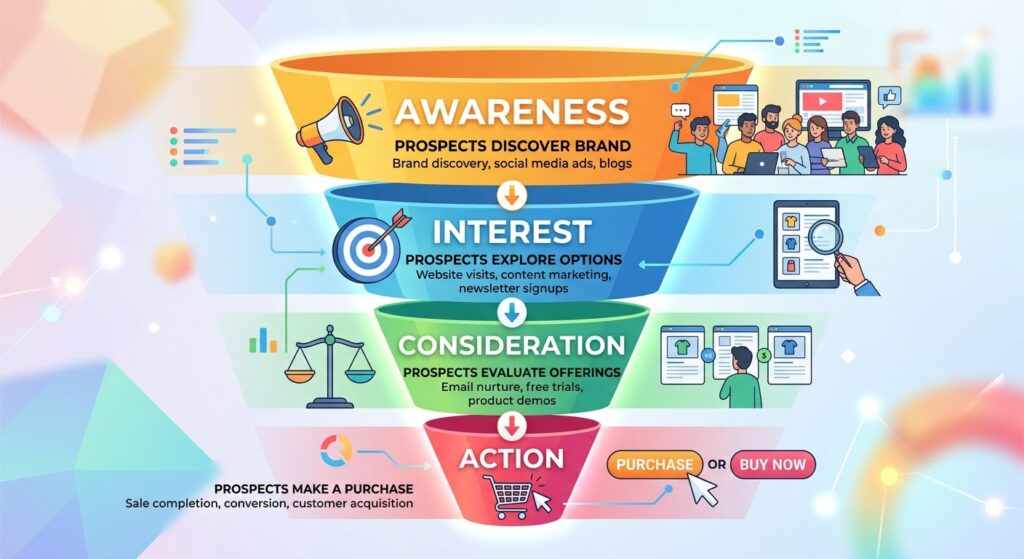
To illustrate how to apply it, let’s use the example of selling cat food online using Google’s advertising platform.
First, a couple more quick caveats:
- I can appreciate that this example, which only worked because Google could track you across the internet, is probably not the best example of ‘benign marketing’ in action, and
- Google’s advertising model has changed completely since its pivot to AI Search, so it doesn’t work like this anymore.
However, because Google’s advertising platform used to offer the entire marketing funnel, it does makes the concept simpler to explain.
Awareness
The top layer is awareness: you want to make people aware of the thing you are offering.
Taking this cat food example, doing so within the Google Ads platform might involve:
- putting banner advertisements on related websites (e.g. pet shops, pet insurance, etc.)
- creating sponsored results for Google Search.
This allows the adverts be targeted and hopefully not be put in front of anyone who has zero interest in cat food.
However, there are many types of cat food, and at this stage the advert is not yet likely to be specific enough to entice many sales. There is still some way to go in narrowing down who is actually going to be interested enough to want to buy it.
Interest
The next step is to identify who from the top layer of the funnel is interested and to follow up with more advertisements – this time giving more context about the specifics of what you are offering.
This is why marketers are obsessed with analytics: it’s hard to find the interested people to focus on if you don’t have any feedback as to whether they’re interested or not. One reason why digital advertising platforms became so popular is that they make it much easier to track what potential customers were doing.
Back to the cat food example. After you have run your Search Ads and Banner Ads, Google shows you who clicked on your adverts but didn’t go straight to your website to buy the cat food. You then run another round of adverts targeted at them, that give a bit more information about what makes your cat food special.
Some of those initially interested people might realise at this point that your cat food isn’t for them, and that’s fine. This is how the funnel works: you only follow up on those that keep showing interest.
Consideration
Now we come to the psychology part: consideration. You might have heard it said that a person needs to see an advertisement more than a certain number of times before they even notice it. This is a marketing principle called Effective Frequency and it dates back to the 1880s (not a typo: the eighteen eighties).
As customers we tend to take time to decide whether to act on something being promoted to us, however tempting it might at first seem. The job of the marketer is to fully understand the value of what is being offered, and to keep emphasising different aspects of it to those who show interest. It might be reasonable to expect that someone who saw your cat food advert three months ago might see another one yesterday, and only today go to your website start reading the small print. At this point, you should be sure that your website answers all of their questions.
Action
The bottom of the funnel is action – whether it is buying the cat food or choosing not to.
If you make buying it as easy as possible by identifying and removing any points of friction then you will improve your chances.
However, I think it is important not to make customers feel pressured to act. As a customer I know that I ever feel like a business is deliberately making it difficult or awkward for me to reject at this stage, I will reject the offer on principle. Make your most compelling case and then leave the choice up to the customer.
Little and often
A fundamental principle that I hope the marketing funnel makes clear is that a ‘little and often’ strategy of talking to your intended audience is usually much more effective than one big push. Before I learned these principles, I assumed that a good way to promote something might be a single media appearance or a single high profile event. I found out (the expensive way) that this is not the case.
How can researchers use this?
You don’t need to pin a marketing funnel to your desk, but it is worth understanding why marketers use this process.
When we first try to promote things, we all tend to believe that we can build an audience with a single action. If we can get a paper in that prestigious journal, or get mentioned by that international news channel. We all tend to be disappointed with the results: there is a spike in interest, smaller than we’d hoped, which fades very quickly.
Building an audience is an active process that requires finding where your target audience is and talking to them in a focused way that offers them real value. You might reasonably be thinking that this sounds like a lot of work. That brings us neatly onto the next topic.
An infinite number of tools
Pretty much every researcher I have spoken to about promoting their research career says they feel overwhelmed and don’t really know where to start. This is a very reasonable response, because in the digital age it seems like there are infinite ways in which you can communicate.
Aside from papers, books and conferences, you can have a blog, be on LinkedIn, be on Bluesky, have a newsletter, have a TikTok channel, have a YouTube channel, have a Substack… the list goes on.
Time, money & focus
What I want to do next is go through these tools and give my opinion on their pros and cons for researchers. I think you could argue that almost all of them can provide some value, even if it’s just a small amount.
However, for most of them that value might not be worth the trade-off of time and focus, and for some there are negative side-effects that outweigh any positive outcome they might produce. I always start by trying to determine how much bandwidth the client has. You can only take on what there is the time, money and focus to do well.
For anyone taking on marketing and promotion themselves, finding the time is obviously a challenge, but for researchers I think the focus can be even more of a problem. The nature of academic research is inherently complex, and even aside from the research itself there is so much institutional information to keep in mind. So many relationships, so many policies, so many acronyms, so many Oxford quirks.
So when I review these potential promotional ‘tools’, as I call them, I will be doing it with these specific researcher trade-offs in mind.