

On this page I will try to lay out all of the different channels and tools that I am aware of for promoting research and a researcher career. Let’s start with the most important, and arguably still the most effective.

Publishing & conferences
There is a reason why publishing articles/books and presenting them at conferences is the standard means of disseminating research in academia, and has been for a very long time. In an extremely competitive landscape that might not be enough by itself, but it absolutely works. It is a process that is focused on not just disseminating but discussing, dissecting and occasionally dismantling research, without distractions.
Before we get to non-academic forms of dissemination, however, there are additional internal channels to explore.
Researcher-specific platforms
I want to give an honourable mention to online platforms such as Researchgate and Academia.edu that help researchers connect with peers and the research community as a whole.
I must confess, not having been a researcher myself, that I am only aware of these platforms and not familiar with them – at least not yet. When I have more insight into the pros and cons of each I will try to review them here too.
Internal networks
At a research institution as large as Oxford, there are systems in place to help spread research beyond just other researchers. There are networks to help promote to government policy, to industry, to NGOs and beyond. I’m focusing specifically on the University of Oxford (at least for now), and these are the internal networks that I know – there might well be similar networks elsewhere.
For government policy
Oxford Policy Engagement Network (OPEN)
OPEN helps researchers connect their work with policymakers in government, Parliament and public bodies. It provides training, advice, funding opportunities and practical support to help researchers contribute evidence to policy discussions and decision-making.
For industry
Oxford University Innovation (OUI)
OUI is the University’s commercialisation and technology-transfer company, helping researchers turn ideas and discoveries into real-world applications. It supports activities such as patenting, licensing, consultancy, spinout companies and partnerships with industry.
EnSpire Oxford supports entrepreneurship and innovation across the University, helping researchers explore how their ideas might create social, commercial or environmental impact. It offers training, mentoring, networking opportunities and programmes designed to help researchers develop entrepreneurial skills and connect with potential collaborators and investors.
For NGOs & Outreach
Public and Community Engagement with Research (PCER)
PCER helps researchers involve members of the public and community groups in their research and its dissemination. It provides training, funding and practical guidance for activities such as public events, workshops, co-production projects and community partnerships.
Knowledge Exchange & Impact staff and Public Engagement staff work across the University’s divisions and departments to help researchers connect their work with audiences beyond academia. They can provide advice on developing impact plans, building partnerships with external organisations, engaging different stakeholder groups and demonstrating the wider benefits of research.
For media
Public Affairs Directorate (PAD)
PAD manages the University’s communications, media relations and public affairs activities. Researchers can work with PAD to publicise significant research findings, engage with journalists and communicate their work to wider public audiences.
Researchers are generally advised to connect with the Innovation & Engagement team within Research Services early when they have a significant finding, especially those with potential for public engagement, commercial development, or strategic impact.

High quality video
Aside from the channels offered by the University, what is the best way to reach a large audience?
In my experience, the preferred option for Oxford staff, be they academics or researchers or professional services, tends to be to call on one of the many talented filmmaker companies in Oxford to create a high quality professional video promoting what they do.
Everybody wants to make a video.
Now, if you have website that gets a large number of visitors, or a YouTube channel that regularly gets a lot of views, this can have its merits – although even they are limited for a single video, however well-produced.
If you don’t already have a platform with a large audience ready to watch it, I think it is very likely that it will never get more than 100 views on YouTube, and you might not even get more than half the visitors to your own website clicking to watch the video, because it doesn’t offer them any value. They can tell what you do by reading the rest of the web page, and they don’t need to be persuaded that you are a professional organisation: the Oxford logo takes care of that.
That said, everybody wants to make a video. I think it can be such an exciting prospect to see your work presented this way that it might not always be the most rational of decisions. In which case, my advice would be to enjoy the process!
If you have yet to make a decision on whether to do this, however, I would suggest there are much cheaper and more effective approaches to take.
Events


In-Person
Another popular option is to put on an in-person event presenting your work. This is a good option if the aim is engagement with the local community – an area in which the Research England Knowledge Exchange Framework suggests the University of Oxford has some room to improve. It might not be the most effective option, however, if the aim is to promote the actual research.
This may seem counter-intuitive. After all, as mentioned above, academic conferences are the lifeblood of research promotion and, even outside academia, in-person events are the bedrock of most modern marketing campaigns. Authors want you to come to book-signings, musicians want you to see them perform live, filmmakers want you see their films in the cinema. Being in a room together has the potential to build a lifelong connection with an audience.
However, whilst conferences are crucial for researchers communicating with their peers, and entertainers and artists rely on in-person events to build a connection with their audiences, I think it is somewhat more complicated for researchers to use one-off events to reach people outside of academia.
You need to find an audience of people interested enough to take time from their busy lives to attend. You need to organise the event, which tends to be a surprising amount of work even for an experienced event organiser. Furthermore, even a successful event tends not to have impact for long.
In-person research events can be a big success, however, so I would not rule them out. I once took part in a very well-attended lecture and music evening that took place under the Tyrannosaurus Rex exhibit at the Natural History Museum that I still remember fondly.
Online
Online events (i.e. some kind of video call) lack that in-person connection. However, I think they can be underrated. They tend to be much easier to run, and to promote. Anyone can attend, from all over the world. You don’t need to hire support or get public liability insurance in the same way.
Perhaps most importantly, if you find a format that works you can do them regularly (even if infrequently), and that is where I believe the benefit really starts to show.

Mainstream media
I can still remember a time when marketing and comms people would talk about ‘Media’, and would categorise it into television, newspapers, radio, magazine, etc. Now we might refer to it as ‘Mainstream Media’, or even ‘Legacy Media’, and those media organisations are currently format-agnostic: they’re all on everything.
Promoting research to these outlets is the speciality of PAD (Public Affairs Directorate – see above): they have the contacts and the understanding of what these outlets want. Details on how to contact PAD are above. I want to emphasise, however, that they will only be interested in significant research findings that might be of interest to a general audience.
This obviously limits how useful this approach can be in promoting your research, never mind your research career. However, it can pay off, and it can put your research into some important public conversations.
Once again I’ll come back to a recurring theme: this is likely to provide a brief one-off spike in attention which will pass surprisingly quickly. Which is not to say it’s worthless – far from it. Interviews on BBC radio or mentions in broadsheet newspapers can be promotional assets that you refer to again and again. It is down to you, however, to do that repeated referring.

Paid advertising
I don’t recommend using paid advertising to promote research, but if I am evaluating all the options then it should at least be considered – particularly if social media companies like Meta tend to treat their content algorithms as ‘pay to play’.
In terms of how effective paid advertising is in the digital age, I think YouTube science communicator Hank Green put it best:
‘Paid advertising is a wet noodle.’
What he meant is that it is very difficult to move anything with a wet noodle, unless you have a huge amount of wet noodles. Hollywood movie promotion might be an example of having a huge amount of wet noodles: the movie stars appear on every podcast, there are posters on buses, product tie-ins, and so on. However, to have an impact this promotion really does need to be ubiquitous. Sometimes a movie will bomb at the box office because ‘no one even knew it was out’, despite studios paying tens of millions of dollars.
When I have run paid advertising campaigns online I have only found them to be effective in boosting content that was already performing well organically. If no one found the content interesting before the adverts, money is not going to help.
Podcasts
Now we start looking at the more modern digital media options.
Appearing as a guest on a podcast can be an excellent way to promote your research and your career. There are a huge number of podcasts out there, and researching appropriate ones and contacting the podcast producers directly is something that a researcher can reasonably do themselves.
Producing your own podcast takes a huge amount of time and effort, and I would only recommend this as a hobby that you occasionally leverage for work.
Video podcasts on YouTube
Many podcasts have moved to YouTube in recent years, taking advantage of YouTube’s powerful recommendation algorithm.
Not everybody feels comfortable being on camera, so it isn’t for everyone. YouTube podcasts do have the advantage, however, of being easier to estimate in terms of impact, because each video has a view count and a space for comments.
Popular blogs
I would apply the same advice on podcasts to websites like The Conversation – great if you can feature on them, but after an initial spike in interest you might need to keep promoting them yourself.
Substack
Many people I know follow creators on Substack without even really knowing what Substack is.
I think it began as an email newsletter platform, similar to Mailchimp, but it is now a whole ‘content ecosystem’, including videos, podcasts, and a ‘For You/Following’ microblogging feed. It is a huge, growing platform that is well-suited to promoting research because it allows for essay writing in various forms. Public figures like economist Paul Krugman and historian Heather Cox Richardson write on it every day and have huge audiences.
Like all of these platforms, however, building a large audience requires posting very frequently. Additionally, like so many of these platforms, it has received criticism for its lack of content moderation (in not just platforming hate speech but promoting it). This ‘proximity problem’ (being promoted next to hate speech) is a reason why many choose to avoid it.
Social media
Understand how social media has changed
You are probably familiar with ‘enshittification‘ – a term that has been ubiquitous in discussions on Big Tech and social media in recent years.
In my personal opinion, everyone seems to acknowledge its existence except marketers. Too often I find marketing professionals talking about the current social media landscape as if it is still 2015. I wonder, perhaps cynically, if that’s because the only people who regularly enjoy using these platforms are doing some kind of marketing.
This is a large part of the reason why I wanted to create this advice section of my website. When I started working in university communications in 2010, Facebook was hugely important because at that time it seemed to be eating the entire Internet. Many scandals and competitors later, I would recommend avoiding it completely in most circumstances.
I believe that the days of social media being the first and best option for promoting anything are over and, whilst many platforms can still offer specific value, they can quickly become an administrative burden for anyone trying to use them infrequently.
There is even the question of whether ‘social media’ is an appropriate term anymore. Many of these platforms are barely social, and are best thought of as bespoke algorithmic feeds of user generated content.
I am going to try to put them into categories to make them easier to evaluate, but first I want to clarify what I feel is the elephant in the room.
The business model of social media
Social media was often a joyous place in the days before the companies figured out the business model, when they were just trying to provide as much value to users as possible.
Now the business model shapes everything on these platforms, and it is broadly this:
- In order to get money from advertisers, the platforms need users (i.e. you) to see their adverts.
- In order for you to see their adverts, you need to be scrolling as much as possible.
- In order for you to be scrolling as much as possible, the content needs to be as addictive as possible.
- In order for the content to be as addictive as possible, creators (also you) need to be incentivised to make the right (usually shocking/outrageous) content.
- In order for this to work, platforms try to get creators addicted to the gamified ‘number go up’ experience of back-end analytics.
Creators often end up trapped making sensationalist content that they are unhappy with because it is the only way to maintain attention.
The Community Platforms
These are the social media platforms that are still social, and I’m going to start with an unlikely contender.
Discord

Discord is a group messaging service that is very similar to office tools like Slack and Microsoft Teams. It allows users to create and categorise a number of social media feeds on given topics. It first became popular as a place for discussing computer game fandom, but it has grown to be a more general community-building platform.
It is not actually a platform that is likely to help researchers promote their research, but it is a useful concept to understand, because I believe the way to use many social media platforms today is to treat them as if they were Discord.

LinkedIn is the pretty obvious front runner when it comes to professionals (of any kind) using social media. For anyone interested in career advancement it is definitely worth considering.
However, it is still a social media platform and it does still have social media incentives. If you are a researcher and you want to play the game of views, LinkedIn will try to turn you into a science influencer. It will try to get you to leverage your research expertise to talk about topical issues you may not be an expert in.
That said, if you treat it as a place to network and do community-building, rather than simply broadcasting to an audience of followers, it can be well worth the effort. If you treat it like Discord, rather than Instagram or the place formally known as Twitter, I think it can be worth your time.
Bluesky

Personally, I love Bluesky, and I believe the underlying architecture (the AT protocol) to be the future of the social internet. Along with Mastodon (see below) it forms part of the ‘decentralised’ social internet: in other words, a collection of social media ecosystems where user-generated content is owned by users and can be moved from platform to platform.
I predict it will become increasingly important in the next five to ten years. However, it is still very early days, and it is absolutely not the thriving knowledge-economy ecosystem that (for better and worse) Twitter was a decade and a half ago.
As with LinkedIn, I think it is currently best for networking and cultivating communities of like-minded researchers.
Incidentally, I often recommend this post, explaining some of the quirks of Bluesky culture.
Mastodon

There is a certain amount of rivalry between Mastodon and Bluesky, particularly between those on Mastodon who see Bluesky as overly commercial and not truly decentralised.
Perhaps the biggest cultural difference is in how information spreads. Mastodon deliberately rejected the features like ‘quote post’ and ‘global search’ that allowed tweets to go viral on Twitter. For this reason I don’t recommend using Mastodon to promote research, because restricting the reach of posts is part of its DNA.
But it can be a great place to discuss research, and there are many scientific communities who have made their home there (e.g. Fediscience).
The Video Platforms
The current three biggest ‘social media’ platforms are based around video: YouTube, TikTok and Instagram. I would say they are approximately as influential as each other in different ways.
Before we explore them in one detail, there is point I want to make clear: it is almost impossible to overstate how competitive these platforms are. Each has tens of millions of videos uploaded each day and, whilst they all have sophisticated algorithms to show viewers the videos they are most likely to watch, no algorithm can work efficiently at that scale. The only way for creators to be successful over time is to understand that algorithm deeply and prioritise above everything else what it wants at any given moment.
YouTube

YouTube is arguably the biggest media platform in the world. More people watch YouTube than any other streaming service. It is increasingly replacing television, or perhaps even becoming television.
Of the big three, YouTube is perhaps the most suited to promoting research. It allows for longer, more substantial, more thoughtful videos, and it is the only platform of the three that makes it (relatively) easy to follow creators you like – thus allowing creators to build up loyal fans.
If you have unlimited budget, unlimited patience and quite a lot of luck, a YouTube channel is probably the best social media path to promote research.
However, even with infinite resources, it is increasingly difficult to get anything other than sensationalist content in front of a large audience – simply because YouTube’s algorithm cannot cope with the scale of videos on the platform. So I would strongly recommend against researchers trying to play the YouTube game as a way to promote their research. It’s just too competitive.
Having said that, I think having a YouTube channel and using it to host low cost videos about your research, that you can promote in other places (rather than relying on the YouTube algorithm to promote them), is a very good idea. If you free yourself from having to constantly feed the Algorithm Beast, you can take the time to make videos that explain your research really well, and it has never been cheaper and easier to make good videos.
I would also add that if you have a strong desire to make a YouTube channel as a hobby rather than something you do in your work time – to promote your research or not – I would highly recommend doing so. It can be really satisfying, particularly if you are able to build up a community around your videos. It is excellent practice for how to communicate, and a great way to understand how marketing works.
TikTok

Let’s say you don’t want to build up an audience over time who regularly listen to what you have to say. Let’s say you just want to go viral. TikTok is the platform for you.
Of the big three, TikTok’s algorithm prioritises reaching the widest audience.
I often see academics with publishing deals posting on TikTok every day, because that’s how you satisfy publishers that you are sufficiently promoting your own book. For good reason, as this is often an effective strategy.
TikTok also allows you to download your own videos and post them (with the TikTok logo) on other platforms like Instagram (Reels) and YouTube (Shorts), so it makes sense as the first port of call for anyone making short-form videos.
As with YouTube, however, it’s getting harder and harder to reach large audiences as more and more videos get uploaded. Until recently every new TikTok creator was competing with teenagers who spent every waking hour learning how to win. Now each new creator is competing against shady ‘creator factories’ making optimised content at an industrial scale.
As with YouTube, there can definitely be benefits to creating a channel to promote your work, but I think these need to be weighed against the sheer amount of time and energy that it is likely to take to get even a modest result.
Instagram (& Threads)

Instagram is still a digital media giant with a vast amount of daily users. It even has its own Twitter clone within it, called Threads. At the moment, however, it is primarily a TikTok-style video platform, with its Reels feature being far and away its most popular.
In terms of reaching a large audience, it perhaps sits somewhere in-between the impossible YouTube and the relatively easier TikTok.
However, Instagram is now owned by Mark Zuckerberg’s company Meta – the company that arguably pioneered the social media business model I mentioned above. In my experience, creators on Meta platforms feel those perverse incentives far more than on competitor platforms. The algorithm wants you to be a very particular type of influencer, and will punish you for straying from the path.
Having said all this, I have spoken to a researcher who has built a respectable following on Instagram by posting their research as a hobby. Again, if this is something you enjoy doing in your own time then it can absolutely be worth it.
The Legacy Platforms

Facebook was easily the most influential social media platform when I started working in University comms. Now it feels more like a punchline.
If I had to sum up Facebook today in a word it would be ‘opaque’.
In April 2024, Facebook’s parent company, Meta, stopped reporting on how many people were using Facebook – instead choosing to bundle how many people were using all Meta apps (Instagram, WhatsApp, Messenger, Facebook). Tech journalist Ed Zitron has written about irregularities in Meta reporting in more detail, and all of this echoes my recent attempts to draw accurate conclusions from Facebook analytics.
Meta assures the world that Facebook is still very popular, but many are unconvinced – myself included.
Once again, perhaps the best way to use it is like Discord – which is ironic, as the rise of Discord could perhaps be attributed to Facebook users (myself included) frustrated with the decline of the platform who are looking for somewhere else to manage group pages, events, etc.
Facebook Groups and WhatsApp chats

There is one feature in Facebook – the Facebook Group – that still keeps many people on the platform, however. This is particularly the case for special interest groups such residents on a housing estate or parents of children with particular medical conditions. These groups might also stay in touch on the (also Meta-owned) WhatsApp.
Often these groups have been set up and maintained because these people find it hard to stay in touch otherwise, so if you want your research to reach them specifically then these channels are essential.
Twitter / X
I cannot see any good reason to be on X.
When the current owner bought Twitter, he completely re-shaped it to meet his own personal and political ends. He has been very open in advocating for authoritarian politicians around the world. This sort of anti-democratic authoritarianism is fundamentally opposed to the existence of robust, objective academic research. Researchers on X are likely to find themselves swimming against a stream of sewage.
If you are a software engineer or a Chicago school economist, you might find an audience. Even so, I maintain that every post on this platform is a reputational risk.

Personal websites
So far, I have listed a number of options that require a lot of maintenance. Let’s go to the other extreme.
You could just have your own self hosted website, independent of the university, where you explain and promote your research in whatever way you want.
This obviously comes with a big challenge: how will anyone find it?
However, personal websites are making a big comeback in the 2020s. Cory Doctorow, the author who coined the term ‘enshittification’, has not one but two. I think this is because that big challenge of how anyone will find your website is now just as much of a problem on YouTube, TikTok and the rest as it is for a self-hosted website, and self-hosted websites are so much easier to maintain – even if they often involve a bit of a headache to set up.
This allows you to go back to using text, instead of having to worry about cameras, thumbnails, lighting and microphone placement. In fact, the format of the blog – often assumed to have been killed by social media’s pivot video – is arguably the most effective tool for researchers who want to communicate complex ideas to a larger audience. You can keep writing about the same piece of research in short, readable blog posts, from many different angles.
The fact that blogs are usually organised by date, like a journal, removes the expectation that this is somewhere you post every day or every week. If you only have time to write something infrequently, your audience can look at your recent output, organised by date, and immediately get a sense of how much they can expect you to post. This is an advantage of being a researcher: if you post infrequently, readers will probably cut you some slack because they will (correctly) assume that is because you are prioritising actually doing your research!
You are, however, still left with this problem of how anyone finds your website. Even those who are interested are not going to keep periodically checking to see if you’ve posted anything new.
This leads me to the last promotional channel I’m going to recommend, and the one that I have felt for many years now suits researchers the best.

Email newsletters
I will start with an important caveat: most email newsletters, in my opinion, are not very good. They tend to focus only on what the sender wants from the reader, and not what the reader might want from the sender. In fact, I would argue that most university email newsletters are even less good, and that this is a known problem to the people that have to write them (often under pressure from many internal stakeholders).
On top of this, whilst email newsletter platforms like Mailchimp can give you analytics on who opened your emails and where they clicked, these analytics are nowhere near as sophisticated as a platform like YouTube – and this is why YouTubers tend to be so much better at communication than people who just write blogs or email newsletters. YouTubers get a ton of feedback about what works and what doesn’t, and email just doesn’t allow for that.
Even putting this aside, it is vastly more difficult to build up a large audience with an email newsletter than it is on a platform like TikTok.
Why this is my standard recommendation
These problems with the email newsletter format make it a bad choice if you are trying to sell products to as many people as possible. However, this is not what researchers need to do.
Researchers are much better off directly targeting a small group of relevant individuals than a mass of people who are unlikely to be interested. The types of relevant individuals who are likely to be interested in your research will also give you a bit more leeway when it comes to your communication skills. They won’t expect you to be slick. In fact, being too slick can even be off-putting.
Added to this, you do not need to tailor what you write to a sensationalist algorithm. You can just be yourself. Over time, you can keep focusing on writing the kind of email newsletter that you personally would want to read, and you can find a tone and format that feels comfortable to you.
The list of advantages doesn’t stop there.
Guaranteed distribution
Let’s start with what is perhaps the biggest advantage, and let’s go back to that question of how anyone finds your website, or your new podcast interview or YouTube video. They find out because you tell them in your regular email newsletter, which is short and readable and only focused on things the reader is likely to be interested in.
Your audience doesn’t need to keep checking your blog, or log into Instagram and maybe see you in the feed and maybe get a notification, based on the whims of a fickle algorithm. Your audience doesn’t need to come to you. Your writing comes to them, regularly.
You need to get good at writing interesting email subject lines, however. That is a must: it doesn’t matter how good your email is if no one opens it.
You also need to recognise that people are busy, and it’s not realistic to expect everyone on your mailing list will read every email from start to finish. However, as long as they don’t unsubscribe, you always get another chance.
Targeted mailing lists
Building up an email newsletter mailing list is a lot of hard work. However, if researchers do it strategically then I would argue this is the optimal way to spread your research as widely as possible.
You may never have the opportunity to write for the Financial Times, or to develop a YouTube channel with more than 1 million subscribers… but if you can get these influential people in your mailing list, you don’t need to.
Our media landscape is full of communicators with large audiences who are desperate for something new and interesting to post every day. If your field of research is of interest to their audience, they are likely to want to be on your mailing list.
Ownership
For as long as you have the email addresses of everyone on your mailing list, this is a communications channel that you fully own.
The same cannot be said for, say, a YouTube account, when YouTube can arbitrarily delete your channel and leave you no way to reach the audience you might have spent years cultivating.
Platform robustness
There is also the danger of committing to a social media platform only to find it goes the way of MySpace. These user generated media platforms are subject to very competitive market forces, and even the most successful can fail quite suddenly.
Email, on the other hand, is one of the fundamental pieces of Internet architecture. It has been around for decades, and is not owned by any one company or institution. If the online platform you use to distribute your newsletters (e.g. Mailchimp) suddenly goes bust then it’s not too hard to build it again from scratch, so long as you still have those email addresses somewhere.
Easy to make, with content flexibility
An email newsletter is not restricted to a particular format. It allows you to easily link to videos, podcasts, blog posts, events, and basically anything with a web link.
That said, it is fundamentally text, which makes it much easier to put together than, say, a video. This really matters if you have limited bandwidth and you want to communicate frequently. Those video upload times and hours spent optimising thumbnails really add up.
Not subject to churn
I mentioned this briefly, but it’s also worth noting that it takes effort to find a new post from someone you follow on most social media platforms, but it takes effort to not receive a new post from an email newsletter you’ve signed up to. The nature of email newsletters is that there is friction in unsubscribing and, once someone has signed up, they are likely to stay signed up unless they make a conscious effort otherwise.
I do think it’s important to make it easy for your readers to unsubscribe if they want to, because you don’t want to waste their time. However, this natural friction means that if a reader didn’t enjoy your last two newsletters, they are still likely to give you a chance for your next one.
Avoiding the Proximity Problem
Platforms like Substack and LinkedIn are, in many ways, whole content ecosystems that make it very easy to promote your work. They have discoverability algorithms, and allow many different types of content.
However, for a researcher, or anyone posting purely professional work, you have no control over what your content will be placed next to. It could be an obvious cryptocurrency scam, an obvious disinformation news account, a notorious academic saying outrageous content for attention, or even just a host of adverts. This changes the context of what you write, and how it will be received. It can make your content look unprofessional by association.
When you send an email, however, you are in proximity to nothing. Your email is not intrinsically associated with the other emails in the inbox.
Reaching a younger audience
There was a time when social media was the way to reach a younger audience, and so this might seem counterintuitive, but if you want to promote your research now to the next generation of researchers, who might be undergraduates or even still at school, social media might not be the best option.
I was once asked to help a departmental comms team approach students queuing on an open day, and survey them directly about where they got their information about the department from. The results were not at all what I expected. No one was on Twitter or Facebook, which didn’t surprise me – although I was surprised how few people used Instagram. Most of them said they used TikTok and YouTube at least a moderate amount.
However, when it came to where they specifically got information about the department from, I don’t think any had looked at the department’s social media pages. They got their information from plain old University websites. That was where they expected to find the relevant information, and it just wasn’t what they used social media for. In fact, many were ambivalent at best about the merits of social media generally. Some complained that it was just full of adverts, and some had a deeper antipathy the Big Tech platforms.
I think there’s a good chance that signing up to an email newsletter is likely to be a much more acceptable proposition. It’s not asking to be a part of their social life, or part of an online culture they might be trying to get away from. It is a regular email focused on a niche interest, which they can opt out of at any time.
How to make a great email newsletter
May I end with a sneaky pitch?
If you are a researcher with a limited time and resources, you can just start by using the free tier of a number of platforms (I personally use Brevo), and make a few email newsletters to just a handful of people – or perhaps even no one – just to get the hang of it. Then, if you focus on slight improvement with each newsletter, you can quickly have a communications channel that you fully own, independent of your institution, that has a good-sized audience and doesn’t take that much time and effort to maintain.
However, if you have a budget – e.g. for your lab or your research group or network – and you don’t have the bandwidth to write this yourself, this is where OxCommunicate can help. Drop me an email and let’s see if we can put together something that works for you!
The Platform Map
To bring this tools section to a close, some platforms and channels will suit some researchers better than others. None of them (apart from X) is intrinsically bad, and they all have their strengths and weaknesses.
However, I would like to offer my own highly subjective overview of how researchers should use these channels.
I call it a ‘platform map’, and you can download it by clicking the big red button.
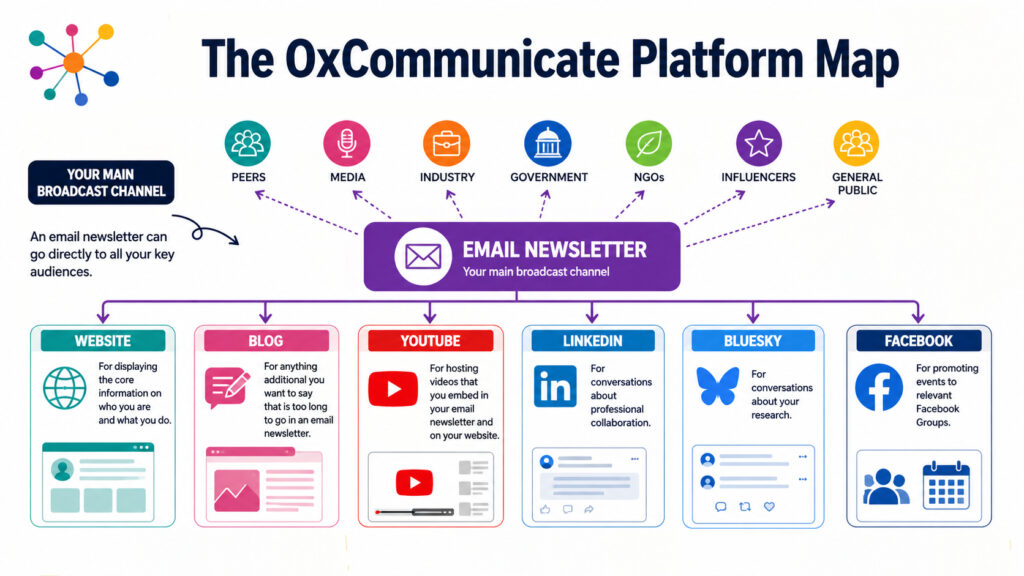
How I suggest researchers use their platforms
In the name of accessibility, I’m also going to write this image out as text.
- Your email newsletter should be your main broadcast channel, and can go to peers, media, industry, government, NGOs, influencers and the general public.
- Your website is for displaying the core information about who you are and what you do.
- Your blog is for anything additional you want to say that is too long to go in an email newsletter.
- YouTube is for hosting videos that you embed in your email newsletter and on your website.
- LinkedIn is for conversations about professional collaboration.
- Bluesky is for conversations about your actual research.
- Facebook is for promoting events to relevant Facebook Groups.
A few more points that didn’t fit
- What are the ‘professional collaborations’ conversations that LinkedIn is good for? Helping your peers, building relationships, offering advice and celebrating the achievements of those you work with (and occasionally yourself if you can avoid it seeming tacky).
- There are now some interesting European variants of Bluesky – Eurosky and Mu – which, being based in the EU, will continue to function even if the Trump administration shuts Bluesky down and demands they hand over all their servers.
- For private conversations rather than public ones, researchers might want to consider Discord, or the more secure Matrix. Signal group chats are also a good option.
- TikTok and Instagram are not in this map, but you might want to link to posts from your newsletter or blog. Remember, however, that Instagram posts from private accounts will not necessarily be visible to everyone.